LC-MS/MS
Liquid Chromatography-Tandem Mass Spectrometry
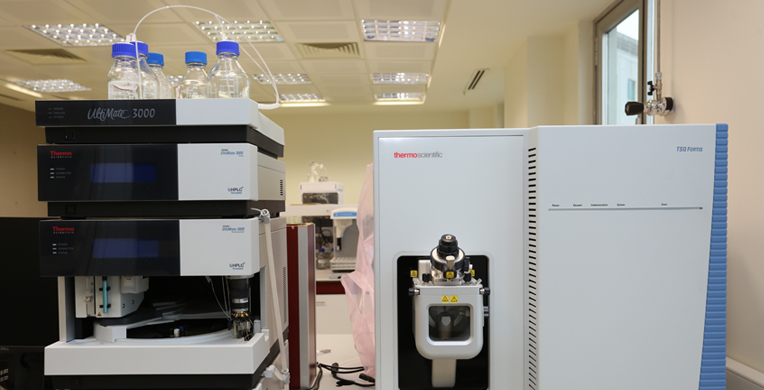
Spectrometry LC-MS/MS is an integrated analytical system combining the physical separation capabilities of liquid chromatography with the mass analysis capabilities of spectrometry. The system consists of high-performance liquid chromatography coupled with a triple quadrupole mass analyzer. The system is equipped with two ionization sources. Molecules are ionized in the source (gas phase) and then transferred to the mass spectrometer. In the first mass spectrometry stage (MS1), precursor ions are selected based on their mass-to-charge (m/z) ratios. These ions are then fragmented in the collision cell using a collision gas (Nitrogen), and the resulting product ions are separated in the second mass spectrometry stage (MS2) based on their m/z ratios. This fragmentation data allows for qualitative and quantitative analysis with high sensitivity and precision. The LC-MS/MS system is primarily used for multi-analyte detection and the sensitive quantification of trace-level analytes. It is widely employed for the analysis of pesticides, hormones, metabolites, and aflatoxin-mycotoxins in food samples such as fruits, vegetables, milk, and meat. Furthermore, it has significant application areas in biological matrices (tissue, serum, plasma) for the measurement of drugs and their metabolites. In addition to multi-analyte determination, LC-MS/MS is one of the most sensitive methods preferred for identifying trace components in a sample. it provides comprehensive information regarding the quantity, chemical structure, and molecular weight of sample components. Its application range is extensive, spanning from the detection of small pharmaceutical compounds to large proteins, as well as the analysis of polar, ionic, thermally unstable, and non-volatile compounds.
Copyright © 2019 PAU - ILTAM