TOC
Total Organic Carbon Analyzer
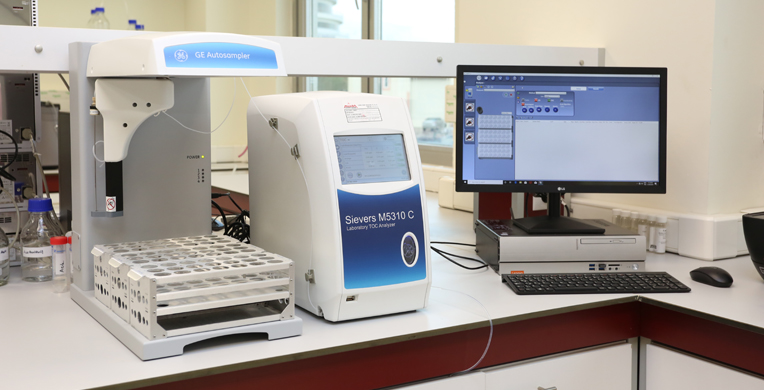
Total Organic Carbon (TOC) is a term used to describe the measurement of organic (carbon-based) impurities within a water system. Organic impurities can originate from a wide variety of sources, as "organic substances" include compounds such as sugars, sucrose, alcohols, petroleum, PVC adhesives, and plastic-based derivatives. Organics may be present in the feed water or may result from the shedding or filtration of various components within the water purification and distribution system. Additionally, they may arise from biofilm (bacterial) growth within the water system.Generally, organic impurities are non-ionic; therefore, they cannot be detected through standard conductivity measurements. Consequently, in an ultrapure water system, high resistivity (low conductivity) measurements may fail to detect significant levels of TOC contamination. High levels of TOC can degrade water purification systems, reduce semiconductor yields, contaminate pharmaceutical formulations, and damage power and steam generation equipment.As one of the primary water analysis methods used in various water utilities, feed water systems, and purification units, TOC determination involves the catalytic combustion of organic substances at high temperatures to convert them into carbon dioxide ($CO_2$) gas. The amount of released CO2 is then measured to determine the total organic carbon concentration in the water sample.
Copyright © 2019 PAU - ILTAM